Seismic networks · Earthquake monitoring · Strong motion
HiDRA
Low-noise short-period seismometer and accelerometer, in one instrument
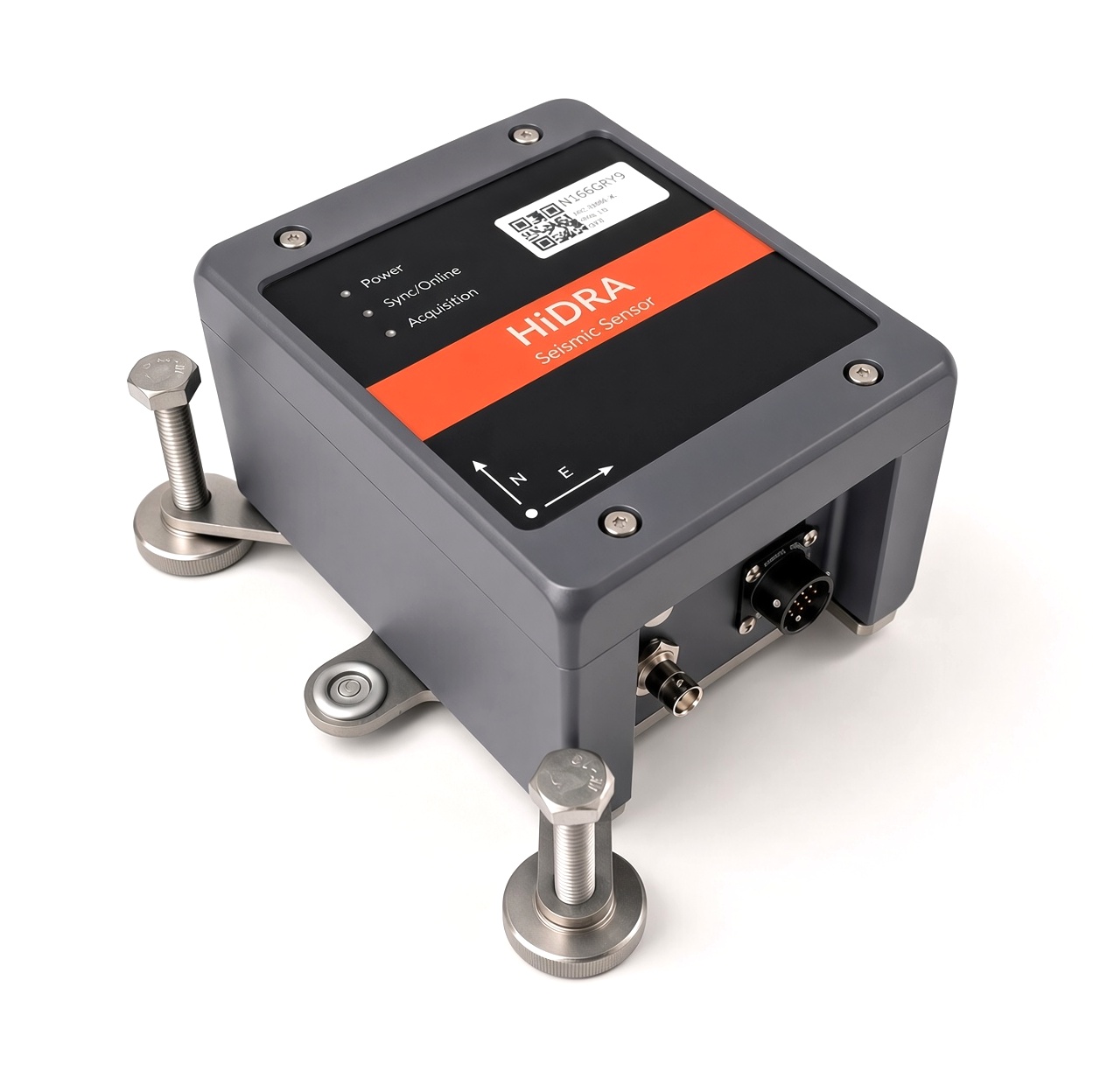
Six channels in one instrument: three short-period velocity channels for earthquake monitoring, and three 20-bit acceleration channels for strong motion — recording simultaneously. Most operators build two separate networks to cover both. Sensor and digitiser are integrated too, so a station is one thing to buy, install and configure rather than three.
Built to be left alone for years
Every part of HiDRA is chosen for unattended operation: the storage, the power range, the update mechanism, the interfaces.
The short-period channels resolve small and distant events. The accelerometers stay on scale through shaking that would clip a seismometer. Both record simultaneously, so one station covers the regional catalogue and the strong-motion record — where that usually takes two networks, two installs and two sets of metadata.
A quad-core processor in every unit runs the full stack. Peak ground motions, intensities, PPSD and spectral ratios are computed where the signal is recorded, so a station on a slow LTE link still reports a result rather than a backlog.
External GNSS pulse-per-second keeps the clock aligned to UTC, so phase arrivals correlate across the network and hypocenters locate cleanly.
Solar, battery, mains, or any combination — the wide input range removes the need for extra regulation at the site.
Industrial pSLC NAND rated for extreme temperature and high write cycles. Data buffers locally through outages and forwards on reconnect.
Match sensitivity to the target signal without swapping hardware, alongside 40–500 SPS selectable sampling.
A SeedLink v3 server and an FDSN WebService endpoint on every unit — ObsPy, SeisComP and Earthworm connect with no glue code.
A/B partition firmware updates verify before switching and roll back automatically if the new image fails to boot.
Edge processing
Data products computed on the sensor
Ground motions, intensities, PPSD and spectral ratios are calculated on the node's in real-time. What crosses the network is already a valuable result.
Raw waveforms stream alongside, never instead. Nothing is computed that you cannot recompute.
How Insights works- STA/LTA triggerEvent detection on the instrument itself with configurable thresholds
- Real-time RMSLocal noise conditions, continuously
- PGA / PGVPeak ground acceleration and velocity
- Instrument intensitiesSpectral and Mercalli scales
- PPSDProbabilistic power spectral densities
- H/V spectraSpectral ratios for site response and resonance tracking
- AutocorrelationSingle-station ambient noise autocorrelation, for rapid change detection
- … and moreNew products arrive by firmware update, on instruments already in the field
Technical
specifications
Wiring diagrams and integration guides live in the documentation.
Sensor
- Type
- 6-channel — 3 short-period velocity, 3 acceleration
- Short-period channels
- 3-component, 1 Hz corner frequency
- ADC resolution
- 24-bit velocity, 20-bit acceleration
- Dynamic range
- 139 dB
- Noise density
- -140 dB at 1 Hz relative to 1 m²/s⁴/Hz
- Acceleration range
- ±2 g, ±4 g or ±8 g, selectable
- Sampling rate
- 40–500 SPS, selectable
- Analog gain
- 1×, 2×, 4× pre-amplification
Connectivity & physical
- Network
- Ethernet, optional LTE
- Enclosure rating
- IP67
- Operating temperature
- −20 °C to +85 °C (−40 °C on request)
- Storage temperature
- −40 °C to +85 °C
Timing & power
- Time synchronisation
- External GNSS PPS, sub-millisecond
- Power input
- 9–36 V DC
- Power consumption
- ~5 W typical, configuration dependent
Computing, storage & interfaces
- Processor
- Quad core
- Storage
- Industrial pSLC NAND
- Firmware
- Customizable SeismiQ firmware, OTA A/B updates
- Data access
- MiniSeed, SeedLink, FDSN WebService, StationXML
- Real-time products
- PGA/PGV, instrument intensities, PPSD, H/V spectra and more
- Custom processing
- Project-specific plugins run on the instrument itself
- Calibration
- Factory-calibrated, optional site calibration through local and remote interfaces
Questions we get asked
9–36 V DC, which covers solar panels, lead-acid or lithium batteries and mains adapters in any combination. The wide input range is deliberate: you design the power budget around what is available on site, without adding voltage regulators.
Other sensors
Tell us what you need to monitor.
Site selection, power budget, FDSN integration — we will scope it with you.