Structural health monitoring • Earthquake early warning • Large deployments
Dense, Affordable Monitoring at Scale
SeismiQ MEMS makes it practical to instrument an entire building, bridge, or campus at a fraction of the cost of traditional seismometers. At just 1 W with optional Power over Ethernet, nodes install wherever there is a network cable – no separate power wiring required.
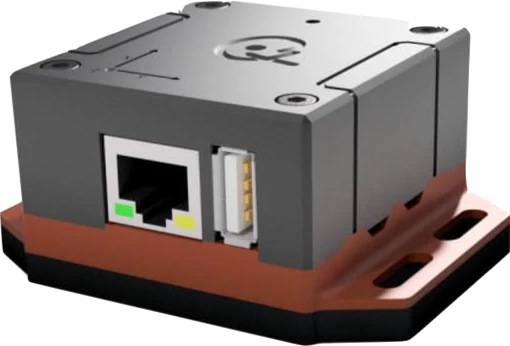
Low-Noise MEMS
3-component 20-bit accelerometer – sensitive enough to detect regional seismic events
Flexible Acquisition
50–500 Hz sampling, configurable gain – adapts to seismic and structural use cases
Single-Cable Install
WiFi or PoE Ethernet – one cable carries both data and power
Compact Form Factor
50 × 50 × 40 mm – installs discreetly on walls, floors, or structural elements
The practical choice for dense, scalable deployments
Traditional seismometers are powerful but expensive and complex to deploy at scale. SeismiQ MEMS breaks that trade-off – delivering sensitive 3-component acceleration data with a compact footprint, standard network connectivity, and the same open-source firmware platform as the HiDRA seismometer.
- Low-noise 3-component 20-bit accelerometer – sensitive enough for seismic event detection
- Selectable 50 / 100 / 200 / 400 / 500 Hz sampling – adapts to structural and seismic use cases
- WiFi and Ethernet – flexible deployment in buildings, tunnels, or field enclosures
- 1 W Power over Ethernet – single cable for data and power, no extra wiring
- Compact 50 × 50 × 40 mm footprint – discreet installation on walls, floors, or ceilings
- Industrial pSLC NAND storage – reliable local buffering during network outages
- SeedLink v3 & FDSN WebService – standard interfaces for seamless software integration
Features in Depth
Everything you need for long-term monitoring without onsite maintenance.
Equipped with a Quad Core processor, the SeismiQ MEMS runs the full SeismiQ firmware stack – including real-time ground motion analysis, PPSD computation, and AI-based event detection – directly on the sensor, without cloud dependency.
Connecting your sensor to a local network is a matter of seconds. Check out our Quick-start Guide for step-by-step instructions for both WiFi and wired Ethernet setups.
Field deployments demand storage that lasts. The SeismiQ MEMS uses industrial-grade pSLC NAND memory, rated for extreme temperatures and millions of write cycles, ensuring continuous data integrity over the lifetime of your installation.
At just 50 × 50 × 40 mm, the MEMS installs discreetly on walls, floors, or structural elements – with minimal visual impact and no requirement for dedicated equipment cabinets.
Scaling a seismic or structural network should not require proportional maintenance effort. Once installed, every sensor is remotely configured, updated, and monitored through the SeismiQ management platform – no site visits required. This makes the MEMS the practical choice for instrumenting entire campuses, bridge decks, or tunnel networks.
Technical Specifications
Full specifications, wiring diagrams, and integration guides are available in the SeismiQ documentation.
| Sensor | |
|---|---|
Type | 3-component MEMS accelerometer |
ADC resolution | 20-bit |
Sampling rate | 50 / 100 / 200 / 400 / 500 Hz (selectable) |
Gain | Configurable |
| Connectivity & Power | |
Network | WiFi, Ethernet |
Power | 1 W, Power over Ethernet (PoE) supported |
| Physical | |
Dimensions | 50 × 50 × 40 mm |
| Computing & Storage | |
Processor | Quad Core |
Storage | Industrial pSLC NAND (high write-cycle rated) |
| Software & Interfaces | |
Firmware | Open-source SeismiQ firmware, OTA updates |
Data access | SeedLink v3, FDSN WebService, StationXML metadata |
Real-time products | PGA/PGV, instrument intensities, PPSD, H/V spectra, AI phase detection |
Frequently Asked Questions
Can’t find your answer? Talk to our team.
HiDRA is a research-grade short-period seismometer with a 24-bit ADC (139 dB) designed for demanding field networks and microseismic monitoring. The MEMS is a 20-bit accelerometer optimised for dense, cost-effective deployments such as structural health monitoring and earthquake early warning. Both run the same open-source SeismiQ firmware and use identical data interfaces.
The MEMS draws only 1 W and can receive both data and power over a single standard Ethernet cable. This eliminates separate power wiring at each node – ideal for instrumenting buildings, bridge decks, or tunnels where running power cables independently would be impractical.
Yes. The industrial pSLC NAND storage buffers waveform data locally during network outages. Once connectivity is restored, data is forwarded automatically – no data gaps, no manual intervention required.
The MEMS is factory-calibrated and ships ready to deploy. Orientation and gain settings are configured remotely through the SeismiQ management platform, so no specialist equipment or site visits are needed during commissioning.
We supply individual units for pilot projects as well as large-scale network deployments. Contact us for volume pricing and lead times.
Ready to instrument your structure?
Our team can help you design a sensor network that fits your monitoring objectives – from floor-by-floor building instrumentation to multi-site infrastructure programmes. Most teams are streaming live data within a day of unboxing.
Talk to Our Experts